
Go West
- Jul 26, 2025
- 5 min read

We're now in Vienna having travelled along the Danube from the Romanian port of Turnu Magurele. From there we've been in Bulgaria, Serbia, Croatia and Hungary. As I've mentioned in a previous post, these are all countries that I learnt a lot about in their pre-1989/90's state under communist rule, although I'd not remembered some of the history so it was good to be reminded.
I really had little knowledge of Bulgarian independence and this was one that really had little impact overall and wasn't mentioned as part of our time in Bulgaria (read more HERE) - in fact we went on a walking tour to admire the view of the Danube and visited a winery! What was interesting was the very obvious poverty of the villages and towns; abandoned and crumbling properties, the result of people leaving villages for the towns and cities. Farming and village life no longer being a viable option for younger people. Outside of the cities it was clear that there was very little financial investment in terms of infrastructure. The roads were poor and we were told about the low birthrate that meant that schools were closing/empty.
From Belgrade, we cruised along the Danube to Ilok, near Vukovar. For the local population war is not a distant memory but one that many were part of - the conflict of the early 1990s where there was much publicised ethnic cleansing and the former Yugoslavia was torn apart and as a result split into six independent countries: Bosnia and Herzegovina, Croatia, Montenegro, North Macedonia, Serbia, and Slovenia. Vukovar still bore the scars of the fighting that brought battle between local Croatian forces numbering 1800 or so defenders and over 36,000 Serbian soldiers.
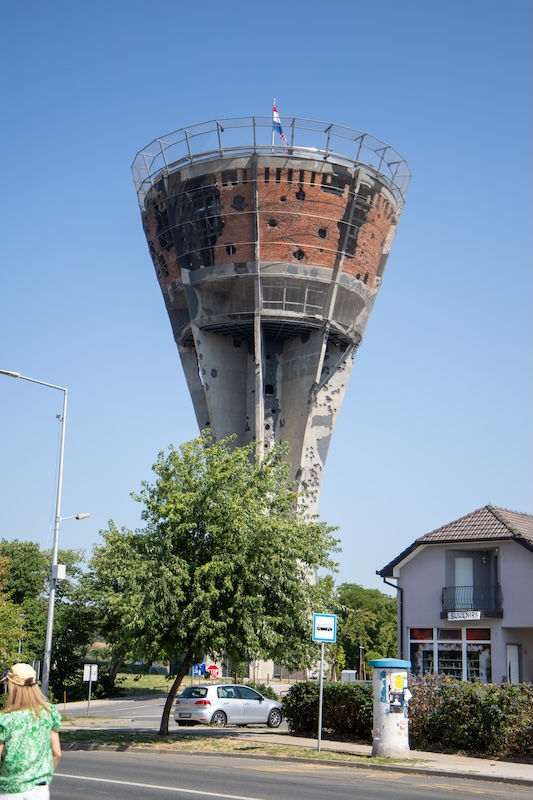
The siege of the town is well documented and can be read about HERE and also seen in various YouTube accounts (one HERE). It took me back to my first time in Taize in the summer of 1986 when I got to know a group of Slovenians. At the time Yugoslavia was a united country but my new friends were not backward in coming forward about their hatred of the Croats. The country was long held together under the leadership of Tito but after his death collapse was, perhaps, inevitable and it all came to a head in the early 1990s (read more about that HERE). The photo to the left is the water tower that shows the damage inflicted by the attacking Serbian forces. As we drove through Vukovar the town has been rebuilt but there are still signs that are visible reminders aside from the water tower - bullet holes in buildings and chunks out of bricks and breeze blocks.
From Croatia to Hungary and the beautiful city of Budapest (pronounced, as we were told a number of times buda-pesht); on one side of the Danube lies the Buda side; the city rises above the river looking over the Pest side which is flat and houses the more lively side of the city with bars, nightlife, markets, shops, culture and museums. Here is another tale of a city that's had it's time under a communist regime. This one different again to the others. Prior to the First World War, part of the powerful Austro-Hungarian Empire but in more recent times a shadow of their past. I'd not been particularly aware of their move from communist power to democracy but was aware of the revolution of the mid-1950s. In 1956, led by a large student body, people revolted against the communist regime. On the cusp of what was thought to be a victory, the revolution seemed to be a success. The USSR was having none of it and sent in a thousand or so tanks (read more HERE). Until 1989/90 Hungary lived tolerating the government and vice versa - the USSR pulling back their power and complete control as a result of the 1956 uprising.
A stark reminder of Soviet power and control, however, was to be found in the House of Terror on one of the main streets in the heart of Budapest. It was here, in this building that the secret police had their base. The building held chilling secrets of not just control of people of Hungary but of imprisonment, torture and death of anyone who dared to criticise the regime or who might be considered of any threat in any way. The museum told the story of the control the regime held over people from the late 1940s onwards. Read more HERE.
As we left the beautiful city of Budapest, having spent three days here there was much to reflect on our time in what was part of the Eastern Block countries under Soviet control. Those who we encountered from the former Yugoslavia spoke in warm tones of time under Tito - who seemed to keep the Soviet Union at arms length, enabling people to travel relatively freely and with some of the benefits of other Eastern Block countries. Romania and Hungary were different kettles of fish - with people crushed and with very few freedoms. It hit home how much freedom I have had over the years; travel, speech, religion. Very few people that I know have suffered persecution or lived in fear that a friend or even a family member might be reporting movements, political opinions or religious activities to the authorities. I was also reminded that as a priest now, if I had been a priest in the 1980s in some of those countries, just by my occupation I would be in danger of arrest, possible torture and/or death at the hands of the authorities. I wonder how that might have affected my life, what I said or did and what I might have preached about! Today I can pretty much say exactly what I want in the front of church as I preach. As a parish a couple of years ago we sent postcards to our local MPs asking them what they were going to do about those in receipt of foodbank parcels - the sort of activity that would have put not just my life but the life of our congregations at risk.
I've not talked much about the treatment of the Jewish community here. We've come across a number of memorials on our travels. Just today in Vienna we saw a memorial in the city centre to those lost in concentration camps. In Budapest we visited the main synagogue and learnt of the ghetto as well as the stark memorial that sits on the banks of the Danube - 60 pairs of iron shoes as a representation of those murdered on the banks of the river (a couple of photos below). These visible reminders of what happened only a relatively short time ago must not be forgotten.
We move on from Vienna to Germany with the beauty of the Wachau Valley and the dark history of Nuremberg still to come. In the meantime, some photos.




For those local to Bournemouth and are interested in hearing more of my 3500+ miles and see a (very) small selection of the few thousand photos taken over the course of the past few months, I'll be having a social evening on Friday 5th September at 7pm at St Luke's Church, St Luke's Road, Winton, BH3 7LR (you can let me know you're coming by clicking HERE).


Comments